
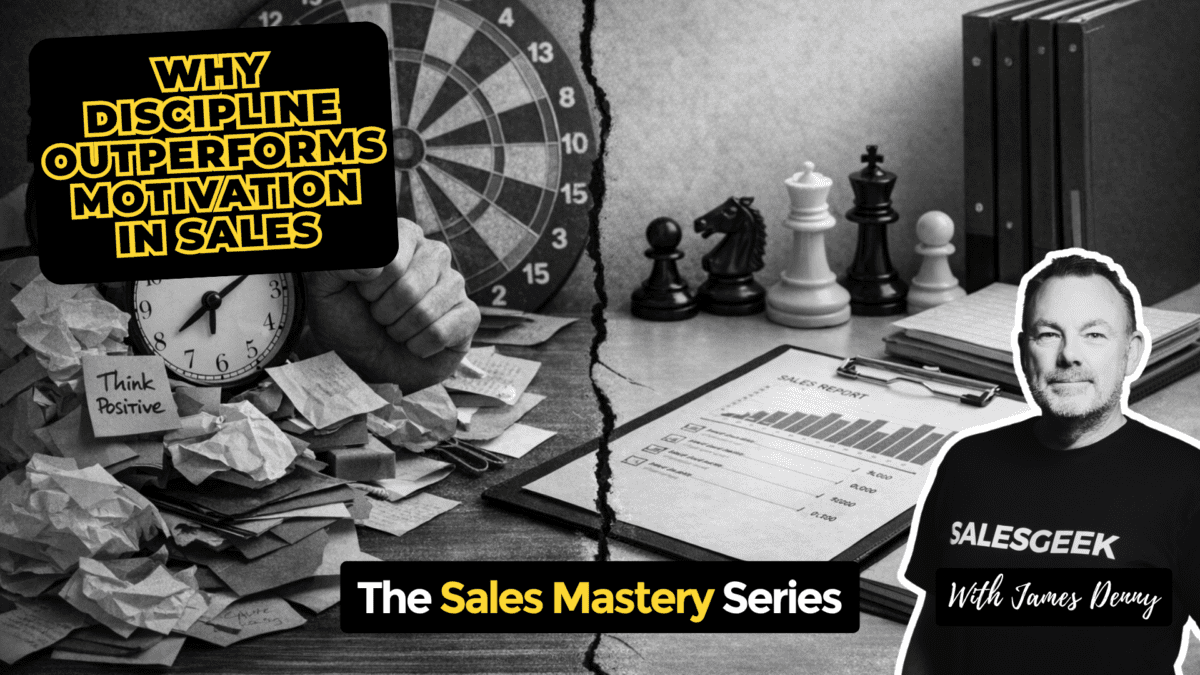
Why Discipline Beats Motivation in Sales
By James Denny, Global COO, Sales Geek
The Sales Mastery Blog is written for sales leaders, business owners and commercial operators responsible for revenue. Each article explores the structural and behavioural forces that shape performance. We look at qualification, forecasting, decision making, pressure and leadership standards through the lens of real experience gained over more than 35 years in sales and senior leadership. Every piece centres on a single commercial tension and examines it with practical clarity. The aim is simple. To give you disciplined, real world insight that helps you build a sales function that performs without chaos.
If you would prefer to listen rather than read this blog please press play below
Click here to read the previous episode of the Sales Mastery series

Why Discipline Beats Motivation Every Time
In the last episode, we challenged the assumption that most sales problems are actually sales problems. We explored the volatility that sits underneath performance: clarity, structure, decision making and leadership behaviour under pressure.
This time, we are challenging another belief that sits at the heart of sales culture: motivation.
Sales has always been associated with energy. Targets. Incentives. Pep talks. Momentum. Urgency. All the things we use to create movement and drive activity. Motivation absolutely has its place.
But here is the truth most people avoid saying:
Motivation is unstable. Discipline is scalable.
If your sales performance relies heavily on motivation, you are building something more fragile than you intend. In this article, we explore why discipline outperforms motivation every time and how to shift from emotional energy to operational stability. Not because motivation is wrong, but because it becomes unreliable under pressure. And pressure is where sales teams need to be at their best.
Motivation Matters, but It Is Not Enough
People need belief, confidence and momentum. Understanding behaviour helps you understand what motivates people to act, and tools like DISC give you a shared language for personality styles.
At Sales Geek, DISC is one of the tools we use to understand how people operate in teams, in leadership, in customer interactions and in decision making.
A quick breakdown:
High D (Driver or Dominant): motivated by challenge and competition
High I (Influencer): motivated by recognition and positive energy
High S (Steady): motivated by stability and reassurance
High C (Conscientious): motivated by clarity and precision
If you know these four things about someone, you can instantly improve how you coach, communicate and lead them. When you understand your customers’ profiles, you can adapt how you sell to them too.
But here is the important distinction:
Understanding motivation does not replace the need for structure.
Behavioural preferences explain how someone likes to operate. They do not guarantee that the system they operate in is strong, robust or fit for purpose.
Motivation is emotional. Emotion fluctuates. Sales environments are volatile. The more emotion you inject into a volatile environment, the more volatility you create.
Why Motivation Fails Under Pressure
When things go wrong: stalled deals, quiet prospects, wobbly forecasts, competitors undercutting. The instinct is to add more energy.
More urgency. More encouragement. More noise. More morale.
It feels proactive. But if motivation was enough, performance would be consistent. It is not.
Motivation creates spikes. Discipline creates stability.
Think of it this way:
Motivation says: “Let’s go.”
Discipline says: “Here is how.”
Over time, “here is how” always wins.
How Behaviour Amplifies Under Pressure
Pressure does not create behaviour. It amplifies it.
At the end of a quarter:
High D pushes harder and skips steps
High I overcommits and stays optimistic long after the deal is gone
High S avoids difficult conversations to preserve harmony
High C delays decisions while waiting for certainty
You have seen all of these. In yourself. In your team. In every sales organisation you have worked in.
This is not failure. It is human behaviour under stress.
It is also why motivation becomes unstable. Under pressure, motivation becomes emotional amplification.
Emotion does not solve ambiguity. Emotion does not strengthen qualification. Emotion does not tighten forecasting.
Discipline does.
Motivation Affects Energy. Discipline Governs Decisions.
Energy fluctuates. Decisions compound.
When pressure hits, you do not need more personality. You need clearer standards.
A disciplined system protects people from their own behavioural tendencies:
High D from recklessness
High I from overpromising
High S from avoidance
High C from overanalysis
Motivation works within a day. Discipline works across quarters and years.
If your sales system relies on constant emotional management, it is too fragile.
What Real Discipline Looks Like
Discipline is often misunderstood. People hear the word and think rigidity, bureaucracy or control.
In sales, discipline simply means:
Clarity applied consistently.
Clarity removes ambiguity. Ambiguity is the killer of most sales operations.
In a disciplined sales organisation:
Deals do not enter the pipeline without minimum criteria
Qualification is defined and agreed
Stages have exit conditions
Forecast categories are criteria based, not emotional
CRM percentages are not mistaken for probability
Evidence replaces optimism
Discipline does not suppress personality differences. It channels them.
And it scales. You can motivate five people. You cannot emotionally manage 200. But you can build a disciplined system 200 people can operate in confidently.
This is not discipline versus motivation. It is discipline before motivation.
How Leaders Undermine Discipline Without Realising
Most breakdowns in discipline originate at leadership level.
Leaders undermine discipline when they:
Make exceptions under pressure
Approve discounts outside thresholds
Allow borderline deals to progress
Change priorities constantly
Celebrate last minute rescues instead of structured wins
Each action sends a signal: standards are flexible, rules are negotiable, structure is optional.
Culture follows reinforcement. If you reward heroics, you get volatility. If you reward discipline, you get predictability.
Discipline is not declared. It is modelled under pressure.
Three Questions to Test Your Discipline
1. If motivation disappeared tomorrow, would performance hold?
If incentives paused and the rallying stopped, would qualification still be followed? Would forecasting still be accurate? Would discount discipline hold?
If energy is the glue holding your system together, the structure is too weak.
2. When pressure increases, what changes?
Do standards tighten or relax? Do you disqualify faster or tolerate more? Do you challenge optimism or accept hopeful forecasts?
Pressure reveals what you truly value.
3. What behaviour do you consistently reward?
Structured progression or last minute rescue? Rigorous qualification or big personalities closing chaos?
Culture follows reinforcement.
Three Practical Resets
1. Define non negotiables
Two or three behaviours that never change, regardless of pressure. Make them visible. Repeat them. Model them.
2. Tighten entry criteria
Most pipeline instability begins at the entry point. Improve what enters the system and everything downstream improves.
3. Coach judgment, not activity
Stop asking: “How many calls did you make?” Start asking: “Which deal is real, and why?” “What evidence supports this stage?” “What decision is missing here?”
The quality of your questions determines the quality of their thinking.
The Irony Most Leaders Miss
Motivation creates energy. Energy feels powerful. But energy without structure is volatile.
Discipline creates clarity. Clarity creates consistency. Consistency creates predictability. Predictability reduces pressure.
The stability leaders chase through motivation is actually built through discipline.
In the next episodes, we will go deeper into DISC, decision making, how deals are won and lost, and how you model disciplined behaviour for your team and your buyers.
If you want to go deeper, you can listen to the full conversation in The Sales Mastery Podcast. Each episode explores the decisions, structures and leadership behaviours that shape sales performance in the real world. Listen on Spotify
For more practical insight, explore topics like fractional sales leadership, Sales Clubs and sales insight across the rest of Sales Geeks social media.
If you would prefer to listen rather than read this blog please press play below
Click here to read the next episode of the Sales Mastery series
Anyone interested in a Sales Geek Franchise should initially download a copy of our prospectus –
UK & Rest of the world – salesgeek.co.uk/franchise-opportunities
USA – salesgeekusa.com/franchise-opportunities
and/or contact the Sales Geek Team HQ in the UK
+44 1254 920 120