

What Sales Leaders Actually Do
By James Denny, Global COO, Sales Geek
The Sales Mastery Blog is written for sales leaders, business owners and commercial operators responsible for revenue. Each article explores the structural and behavioural forces that shape performance. We look at qualification, forecasting, decision making, pressure and leadership standards through the lens of real experience gained over more than 35 years in sales and senior leadership. Every piece centres on a single commercial tension and examines it with practical clarity. The aim is simple. To give you disciplined, real world insight that helps you build a sales function that performs without chaos.
If you would prefer to listen rather than read this blog please press play below
Click here to read the previous episode of the Sales Mastery series
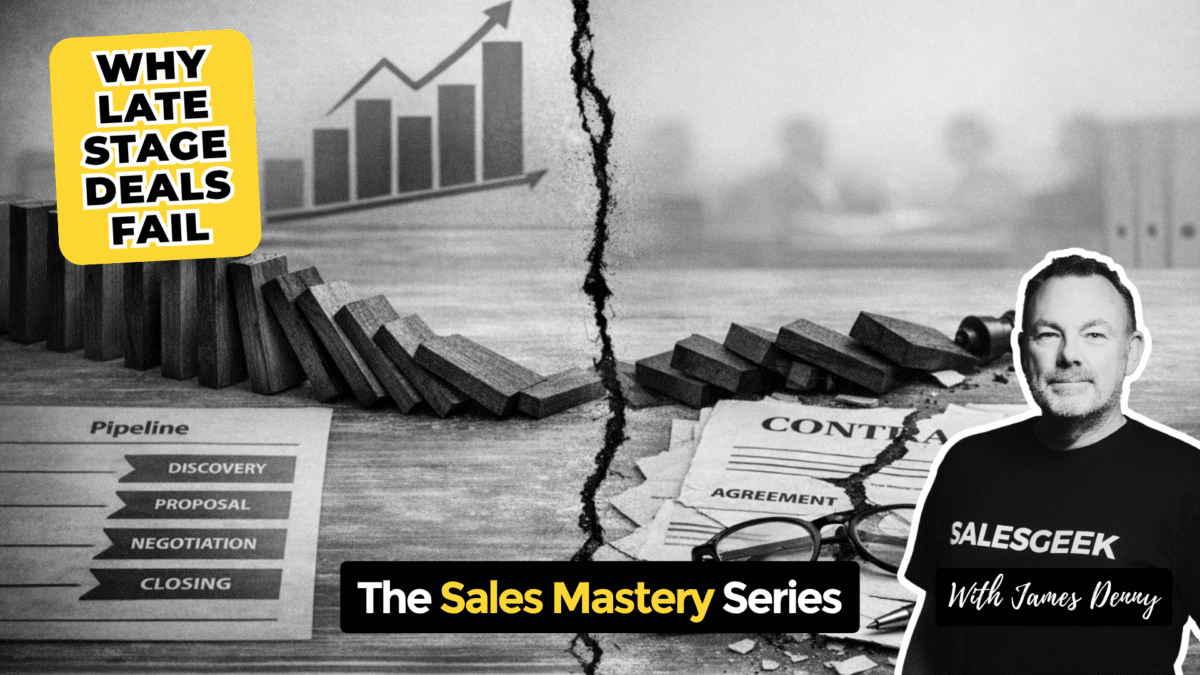
What Sales Leaders Actually Do
Sales Mastery is not about hype, hacks or heroics. It is about discipline, balance, decision making and doing the right things consistently — especially under pressure.
In episode 1, we explored how most sales problems aren’t really sales problems. They start in structure, clarity and leadership behaviour. In episode 2, we established that discipline beats motivation because energy fluctuates but standards stabilise performance. In episode 3, we showed how deals rarely fail at the end — they weaken upstream when qualification and buyer mapping are poor. Now, we move from diagnosing problems to defining something fundamental: responsibility.
What does a sales leader actually do? Not in aspirational or job‑description terms, but in practical, commercial, accountable terms.
The Three Lenses of Sales Leadership
We’ll look at three levels:
The frontline sales manager
The senior sales leader
The business owner who leads sales
The role changes at each level, and clarity of role is the foundation of disciplined performance.
Why This Matters
Let’s take some economic context. In 2026, the UK has roughly 5.7 million private‑sector businesses. Over 99 percent have fewer than 30 employees. In the US, there are 35 million businesses — again, 99 percent under 30 employees. Globally, micro and small enterprises dominate.
That means the typical business is not a multinational with layers of governance. It’s owner‑led, lean, and often has player‑managers leading sales from the front line — carrying a quota while managing a team. Senior leaders wear multiple hats. Founders still feel personally responsible for revenue.
Revenue is the oxygen of these businesses. Sales creates it. Sales leadership protects and scales it. It is not peripheral — it is central to economic health.
If we’re serious about doing sales properly, we must be precise about what the job actually is.
The Frontline Sales Manager
This includes first‑time managers, player‑managers, team leaders and small‑team heads in SMEs. Their job is not simply to hit the number. It is to convert behaviour into predictable outcomes.
They own three core areas.
1. Behavioural Coaching
They must shape how salespeople think and operate. That includes qualification discipline, stakeholder mapping, political awareness and buyer‑behaviour recognition. This is where frameworks like DISC matter. They help identify who owns, influences or slows decisions — and how to engage each type.
If a representative cannot distinguish between a high D executive sponsor, a high C financial gatekeeper, a high S operational stabiliser and a high I internal champion, they will misread signals and weaken deals. Frontline managers must coach that nuance.
2. Gate Enforcement
They own stage integrity — not the stages themselves. A stage is descriptive; a gate is evidential. Before a deal moves forward, proof must exist: authority confirmed, buying process mapped, urgency validated, stakeholder alignment begun. If optimism bypasses gates, mistakes are carried forward. Small errors become expensive late failures.
3. Capability Development
They must grow judgment. Frontline managers often fail because nobody teaches them how to coach judgment. They were promoted for selling, not trained for leading, so they default to activity metrics. A strong manager coaches thinking, protects gates, develops capability and reduces volatility at source.
The Senior Sales Leader
Heads of Sales, Sales Directors, CROs. They do less direct coaching and focus on design and protection of the system.
1. System Architecture
They define stage definitions, qualification standards by deal size, forecasting evidence, discount governance and incentive structures. A £500 deal and a £100,000 deal cannot have identical qualification depth. Small deals need clarity and authority; large deals require stakeholder mapping, political risk assessment, governance understanding and ROI quantification. If qualification depth doesn’t scale with complexity, forecasting volatility is inevitable.
2. Cross‑Functional Alignment
Senior leaders align sales with marketing, product, finance and customer success. Marketing defines brand and campaign positioning. Finance models risk. Customer success drives expansion logic. Without alignment, sales operates in isolation — and isolation breeds friction.
3. Presenting Commercial Truth
The truth matters. It is not the leader’s job to bring reassurance. Average tenure for senior commercial leaders is under two years. Instability amplifies the need for system discipline. Charisma creates dependency; structure creates continuity.
The Business Owner
In 99 percent of businesses, the owner is the de facto head of sales. Sales determines cash flow, hiring, investment risk and strategic flexibility.
Owners must operate at a different level.
1. Strategic Revenue Design
Sales strategy defines what the business is trying to achieve quarter by quarter for the next three years. At Sales Geek, we call this the Theory of Twelves. It covers region focus, customer selection, margin protection and long‑term growth. Sales is not just pipeline volume — it is strategic positioning.
2. Leadership Investment
Hiring senior leaders is expensive; replacing them is more expensive. Turnover disrupts pipeline continuity, culture and rhythm. This is where fractional leadership becomes powerful — senior experience without full‑time cost, reducing risk and increasing capability.
3. Cultural Signal Setting
Owners define what is rewarded. If they reward revenue over margin, optimism over evidence and heroics over structure, they institutionalise instability. If they reward discipline, qualification integrity and forecasting truth, they build resilience.
Connecting Back to Episodes/Blogs 1–3
Who designs structure? Senior leaders.
Who enforces it? Frontline managers.
Who funds and prioritises it? Owners.
In episode 2, we said discipline beats motivation. Managers model discipline through coaching. Senior leaders model it through governance. Owners model it through incentives.
In episode 3, we showed deals fail upstream. Managers protect gates. Senior leaders design qualification. Owners invest in capability.
Leadership is layered accountability. When one layer fails, errors are carried forward.
Reflective Questions
For Frontline Managers
How much of your time is spent coaching judgment versus reviewing activity?
What specific evidence must exist before a deal moves through stages?
How confident are you in your team’s ability to read buyer behaviour and politics?
For Senior Sales Leaders
Does qualification depth scale proportionately to deal size?
Are your forecast categories evidence‑based or subjective?
Where is cross‑functional misalignment hurting predictability?
For Business Owners
What structural investment have you made in sales‑leadership capability this year?
Is your senior leadership stable or volatile?
What fractional expertise could reduce risk and increase independence?
Practical Actions
Managers: Introduce written gate criteria and enforce them rigorously.
Senior Leaders: Audit qualification depth and align it to buyer governance complexity.
Owners: Create a 12‑month and 36‑month sales‑leadership capability roadmap, including fractional options.
Sales Leadership Is Layered Responsibility
Frontline managers shape behaviour. Senior leaders design systems. Business owners define strategic intent and resource the discipline.
Across the UK, US and globally, SMEs dominate. Most businesses depend on a small number of people getting sales leadership right. Revenue is oxygen. Sales leadership controls the oxygen supply.
What’s Next
In the next episode, James moves into execution models — how rhythm, activity and leadership cadence translate discipline into measurable performance. We’ll explore how to build a repeatable operating rhythm that connects structure, behaviour and accountability.
If you want to go deeper, you can listen to the full conversation in The Sales Mastery Podcast. Each episode explores the decisions, structures and leadership behaviours that shape sales performance in the real world. Listen on Spotify
For more practical insight, explore topics like fractional sales leadership, Sales Clubs and sales insight across the rest of Sales Geeks social media.
If you would prefer to listen rather than read this blog please press play below
Click here to read the next episode of the Sales Mastery series
Anyone interested in a Sales Geek Franchise should initially download a copy of our prospectus –
UK & Rest of the world – salesgeek.co.uk/franchise-opportunities
USA – salesgeekusa.com/franchise-opportunities
and/or contact the Sales Geek Team HQ in the UK
+44 1254 920 120